
An exporter ships an order to an international customer, sends the invoice, and expects payment within a few days. But when funds pass through multiple banks, settlement is delayed. They find the final amount is lower than expected due to foreign currency exchange rates and intermediary bank charges.
If this sounds familiar, you’re not alone.
For years, businesses have been relying on traditional banking systems for international payments. But as global trade becomes faster and more digital, these payment infrastructures are struggling to keep up.
As a result, many businesses handling cross-border payments experience delays, unexpected deductions, and limited visibility into transactions. What seems to be a simple process can involve several delays, incur extra costs, and lead to operational inefficiencies for export businesses.
According to the World Bank, global remittance and cross-border payment costs remain significantly higher than domestic transaction costs. What businesses really need today is a faster, more transparent, and easier way to manage cross-border payments.
Today, international collections play a key role in how businesses manage cash flow, efficiency, and growth. In this blog, we will explore how traditional bank transfers can cost businesses a bomb, the challenges they pose, and modern payment solutions that enhance cross-border payments.
Key Takeaways
- Traditional cross-border payments often involve multiple intermediary banks.
- Foreign exchange markups, delayed payments, and limited payment visibility are some challenges exporters face.
- Payment infrastructure in a company directly impacts cash flow and operational workload.
- Modern digital payment systems mean faster settlements, better transparency, and simplified reconciliation.
Why Traditional International Payments Are Becoming Inefficient
Global commerce has evolved rapidly over the past decade. Now, exporters sell to customers worldwide, manage international supply chains, and have become a part of a digital-first working environment- an ecosystem in which speed and transparency remain unshakeable.
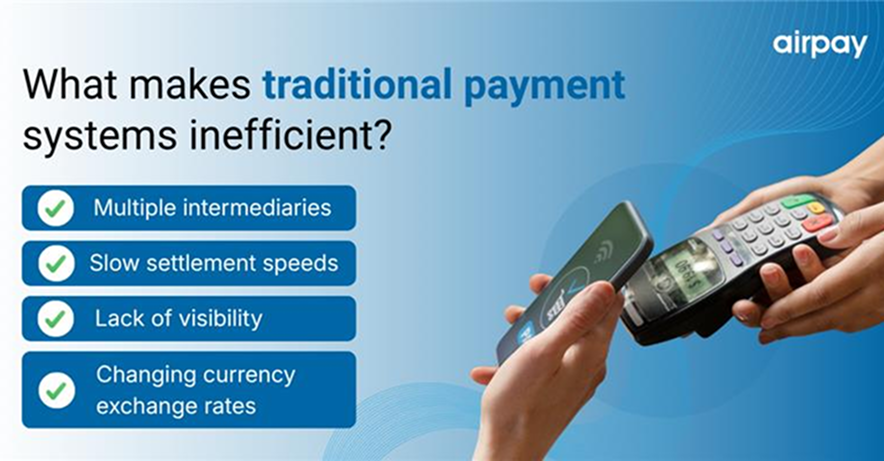
On the flip side, many cross-border payment systems still rely heavily on the traditional banking infrastructure designed years ago, resulting in challenges like:
- They work through corresponding banking networks, meaning going through several intermediary banks prior to reaching the final recipient. With every intermediary in place, new additional fees, processing delays and limited transparency are added at each step.
- Tracking payments becomes difficult with a lack of visibility into transactions and hampers predictable cash flow.
- International bank transfers usually have a slow settlement speed (2-5 business days, depending on the location).
- Exchange currency conversion can cause a difference in the expected and final money received.
Due to these challenges and slow transaction processing, traditional banking infrastructure is becoming inefficient at powering global collections in the modern global economy.
Common Challenges Exporters Face with International Payments
When exporters depend on traditional bank transfers for international payments, the following operational challenges can arise.
Limited Payment Visibility
Businesses might not get real-time insights into the payment journey, and this can make it challenging for finance teams to track incoming payments.
Manual Reconciliation
Finance teams may need to match incoming payments to invoices, verify deductions, and manually resolve any gaps.
Intermediary bank charges
Payments that pass through multiple correspondent banks incur additional processing fees. The recipient will learn about those deductions only when they appear in their account.
Delayed Settlement Timelines
Cross-border payments can often take several business days to process, leading to settlement delays. This impacts cash flow and financial planning.
Fluctuations in foreign exchange
In international transactions, currency conversion depends on the exchange rate at that time. So, the amount may differ from what it was when the invoice was generated to what it is at the end.
These challenges slow payments and make it difficult to manage a company's financial operations.
The Hidden Costs of Traditional International Bank Transfers
International collections may seem straightforward, but they come with several hidden costs that affect exporters' businesses.
These are:
Transaction and Processing Fees
Businesses handling international payments might have to pay charges to multiple parties: the intermediary bank and the receiving banks.
Foreign Exchange Markups
Exporters often get a reduced final payment amount because a lot of money gets deducted in currency exchanges.
Payment Delays
International transfers are time-consuming and hamper working capital, making it difficult to manage operational costs.
Traditional Bank Transfers vs Modern Payment Solutions
| Feature | Traditional Bank Transfers | Modern Payment Platforms |
|---|---|---|
| Time | 2–5 business days | Faster processing |
| Payment visibility | Limited | Real-time tracking |
| Transaction fees | Multiple charges | Transparent pricing |
| FX conversion | Bank markups | Competitive rates |
| Reconciliation | Manual | Automated |
Modern payment infrastructure provides greater transparency and efficiency, making cross-border payments easy to manage.
What Modern Export Businesses Need in a Global Payment System?
With the expansion of global payments, exporters are shifting to modern payment systems that offer:
- Faster settlement cycles
- Transparent transaction fees
- Competitive foreign exchange rates
- Real-time payment tracking
- Automated reconciliation
- Global payment collection capabilities
These features help businesses improve efficiency while reducing operational workload. Therefore, modern export businesses need to update their payment systems as quickly as markets are evolving.
Modern Alternatives to Traditional Bank Transfers for Exporters
Several alternatives have emerged to help exporters manage their cross-border payments more easily. Unlike traditional bank transfers, digital payment platforms have several advantages. These offer:
- Multi-currency payment collection
- Real-time transaction tracking
- Automated reconciliation tools
- Centralised dashboards
- Better foreign exchange rates
With these capabilities, exporters can gain better control and visibility over their cross-border payments.
How airpay Simplifies Cross-Border Payments?
Digital payment platforms like airpay present a host of benefits to remove the complexities of traditional banking systems. With airpay, businesses can:
- Collect payments in multiple currencies
- Track transactions in real-time
- Automate reconciliation tools
- Manage payments through a centralised unified dashboard
- Access competitive foreign exchange rates
By simplifying cross-border payments, airpay helps exporters focus on business growth rather than on payment challenges. Looking to simplify cross-border payments? Get started with airpay today.


