
Recurring payments are supposed to be the easy part of running a subscription, lending, or insurance business. You set up the billing, the money moves automatically, and your team focuses on growth.
Except that's not what actually happens.
Pre-debit notifications go out late or not at all. Mandates get registered incorrectly. Customers hit the Rs. 15,000 limit, and the payment just fails - no prompt, no recovery, just a lost transaction and a confused customer. Cancellations don't close cleanly, so failed charges keep firing after a customer has already opted out.
None of this is a technology problem in isolation. It's what happens when recurring billing is bolted onto a payment stack that wasn't designed for it.
TABLE OF CONTENTS
- What is an E-Mandate?
- What RBI's Rules Actually Require
- Where Businesses Lose Revenue in the Process
- How airpay Handles This at the Infrastructure Level
What is an e-mandate?
An e-mandate is a digital authorisation from your customer that allows you to automatically debit their bank account on a recurring schedule, with fixed or variable amounts at a set frequency. It's the mechanism running behind your SaaS subscriptions, loan EMI collections, insurance auto-debits, and membership renewals.
You'll also hear it called e-NACH (Electronic National Automated Clearing House). Same thing, different acronym.
Before this existed, businesses chased paper NACH mandates: physical forms, wet signatures, and manual submissions. The digital version replaced all of that with a bank-authenticated process. But the operational complexity didn't disappear - it just moved into your payment stack. If your stack wasn't built for it, you're absorbing that complexity as failed collections and manual intervention.
What the RBI's rules actually require
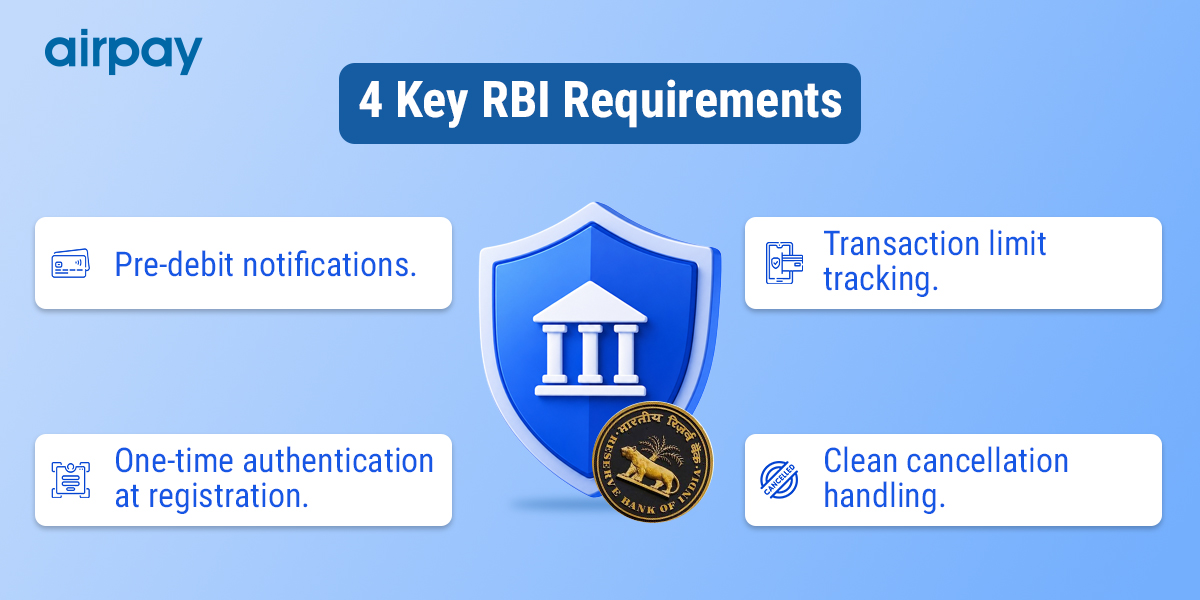
RBI has tightened its e-mandate framework significantly over the last few years. The current requirements are:
Pre-debit notifications
Every recurring debit needs advance notice. The customer must be informed - merchant name, date, amount, at least 24 hours before the money moves. At registration. And on every subsequent debit. Via SMS, email, or both. Transactions without this notification can be reversed by the bank, no questions asked.
One-time authentication at registration
The first mandate setup requires an Additional Factor of Authentication, typically an OTP, to be sent to the customer's registered mobile number. Once that's cleared and the first transaction is processed, subsequent debits run automatically.
Transaction limit tracking
Recurring debits up to Rs. 15,000 process without additional authentication. Above that threshold - or for specific payment categories like insurance, re-verification is required before the payment clears. If that prompt doesn't happen, the payment declines.
Clean cancellation handling.
Customers can cancel or modify their mandate directly through their bank at any time. When they do, the cancellation needs to be reflected in your system immediately. Failed charge attempts after a cancellation aren't just operational noise; they're chargebacks and regulatory exposure.
Where businesses actually lose revenue in this process
The rules aren't complicated. The failures are operational.
A notification goes out late, or doesn't go out at all, because it depends on a manual step somewhere in the process. A mandate is registered with a missing authentication step, rendering it invalid and forcing the entire setup to restart. A transaction crosses Rs. 15,000 without triggering re-auth, so it declines, and no one on your team knows why until a customer complains.
These aren't edge cases. They're recurring failure points in businesses that built their billing on a payment stack that treats compliance as a layer on top rather than a foundation underneath.
The downstream effect: lower collection rates, higher support volume, and regulatory exposure that starts small and compounds.
How airpay handles this at the infrastructure level
airpay doesn't give you a compliance checklist. The requirements are built into the platform. Your team doesn't manage them; the infrastructure does.
Pre-debit notifications run automatically
Every scheduled recurring debit triggers a mandatory notification to your customer, well within RBI's 24-hour window. No separate messaging tool. No manual tracking. It happens on every transaction, without exception.
Mandate registration is built around authentication
. When a customer sets up a recurring mandate through airpay, the OTP step is placed in the correct step in the flow. The mandate is registered with the bank in the correct format. The first transaction processes with full compliance. There's no checklist for your team to verify afterwards.
The Rs. 15,000 threshold is tracked and acted on
airpay monitors transaction amounts in real time and flags any that approach the limit. When re-authentication is required, the customer is prompted before the payment fails, not after. Fewer declines, less friction, fewer support tickets.
Cancellations close without residual failures
When a customer cancels their mandate at the bank, airpay picks it up immediately and updates your records. No failed charge attempts continue running in the background. The relationship ends cleanly on both sides.
Recurring revenue models work when the infrastructure underneath them is built to support them. If your current payment stack requires your team to manage compliance steps manually, or if you're finding out about failures after they've already cost you collections, that's a stack problem.
airpay is built to make that invisible. Sign up here
Frequently Asked Questions
What is the difference between e-NACH and e-mandate?
They refer to the same mechanism. e-NACH stands for Electronic National Automated Clearing House and is the system infrastructure. E-mandate is the term used for the digital authorisation a customer gives to allow recurring debits. In practice, both terms are used interchangeably across the industry.
What happens if a pre-debit notification is sent late?
The bank can reverse the transaction, with no requirement to give the merchant advance warning. There is no grace period. Any recurring debit processed without a valid pre-debit notification at least 24 hours in advance is at risk of reversal.
What is the Rs. 15,000 e-mandate transaction limit?
Recurring debits up to Rs. 15,000 can process without additional customer authentication. Above that threshold- or for certain categories like insurance- the customer must re-verify before the payment clears. If that re-authentication prompt isn't triggered correctly, the transaction declines.
Can a customer cancel an e-mandate without informing the merchant?
Yes. Customers can cancel or modify their mandate directly through their bank at any time, without notifying the merchant. If your payment system doesn't pick up that cancellation immediately, failed charge attempts will continue- which creates chargebacks and regulatory exposure.
How does airpay handle RBI's pre-debit notification requirement?
Pre-debit notifications are built into airpay's recurring billing infrastructure. Every scheduled debit automatically triggers a customer notification- via SMS, email, or both- within RBI's required window. No manual step or separate messaging tool is required.
What happens if an e-mandate is registered incorrectly?
An incorrectly registered mandate- typically one with a missing or out-of-sequence authentication step is invalid. The first debit attempt will fail, and the customer has to go through registration again. airpay's mandate registration flow places the OTP step correctly by default, so this failure point is removed.
Is airpay compliant with RBI's e-mandate framework?
Yes. airpay holds RBI PA-O, PA-P, and PA-CB licenses. The platform's recurring billing infrastructure is built in full compliance with RBI's e-mandate guidelines, including pre-debit notifications, mandate registration authentication, threshold tracking, and clean cancellation handling
Stop managing RBI compliance manually.
airpay builds every e-mandate requirement into the platform — pre-debit notifications, threshold tracking, clean cancellations. Your team handles collections. The infrastructure handles compliance.
Sign up with airpay today →
India · UAE · Tanzania · RBI PA-O, PA-P, PA-CB Licensed


